


Cutting Toxic Cords: A Gentle Ritual to Reclaim Your Energy
Cutting toxic cords is the act of consciously releasing the energetic tie that keeps pulling you back to someone who drains you, and it usually starts with one small, physical gesture rather than a dramatic confrontation. If their name still tightens your chest, that thread is worth addressing directly.
This piece is for anyone exhausted by a connection they cannot quite shake, especially when love and hurt sit side by side. You will find honest signs to check against your own experience, one question to sit with first, and a short ritual using a candle, a length of thread and ten quiet minutes.
In short
- A toxic cord is not the same as love; it is the tie that keeps pulling you back into an old role.
- You can cut a cord without cutting the person out of your life, and without wishing them harm.
- One short ritual, done with a clear intention, does more than a long one done in a hurry.
- A reading can help you see which cord is actually yours to cut and which one is asking for a boundary instead.
What Cutting Toxic Cords Really Means
Cutting toxic cords means ending the inner habit of returning to someone, not erasing them from your life or your memory. A cord, in this work, is the well-worn path your attention travels when it drifts back to a person: the check of their profile at midnight, the argument you replay in the shower, the small tightening in your chest when their name appears on your phone. It is a pattern of return, held in the mind and felt in the body, and it can outlast the relationship by months or years because the habit was never really about the other person. It was about what your system learned to expect from them.
A loving bond and a toxic cord can look similar from the outside, and the difference shows up in what happens after contact. A nourishing tie leaves you steadier, more yourself, able to go about your day. A draining one leaves you second-guessing, tired, scrolling for clues, or bracing for the next message. That is the practical test: notice how you feel in the hour after you speak to them, not during.
Cutting a cord does not mean cutting the person out, and it does not require pretending they never mattered. You can love someone and still stop handing them your energy every time they reach for it. What changes is the reflex, not the history. Many people find that once the pull loosens, they can think about the person with something closer to calm, or simply think about them less. If you want a structured way to work through this, a cord cutting ritual gives the intention a shape, and a tarot reading can help you see which tie is actually asking to be released.
Signs You Are Still Tied to a Toxic Cord
The clearest sign of a toxic cord is not how often you think about the person, but how you feel in your body after any contact with them, even a small one.
- You replay old conversations in your head, editing what you should have said, sometimes months or years after the last real exchange.
- You check their profile, their stories, or their last active time, and you tell yourself it is just curiosity when it happens most nights.
- After a message, a call, or even a passing mention of their name, you feel heavy, guilty, or somehow smaller than you did an hour before.
- You explain yourself more than you want to, justifying a decision you already made, hoping they will finally understand it.
- You track their mood like weather, adjusting your own words and plans so they will not be upset, tired, or disappointed.
- The pull gets stronger at night or in quiet moments, when there is nothing left to distract you and the tie has room to speak.
- You feel responsible for their happiness, their loneliness, or the consequences of choices they made themselves.
- You have tried to move on, and something still tugs you back to the same thoughts, the same guilt, the same loop.
If several of these sound familiar, the connection is still active, and that is worth naming honestly rather than pushing through alone. A shadow work tarot reading can help you see which pattern belongs to this person and which one you have been carrying since long before they arrived.
Before You Cut: One Honest Question to Ask Yourself
Ask yourself one question before you touch a candle or a pair of scissors: does this tie ask me to shrink, or does it ask me to grow? Sit with it for a minute rather than answering fast. The first answer that arrives is often the honest one.
A loving bond can feel intense, even consuming, without leaving you empty. Think about how you feel an hour after speaking to the person. If you are lighter, steadier, more yourself, that intensity is closeness. If you are second-guessing every word, apologising for existing, or bracing for the next message, the tie is asking you to make yourself smaller. That is the signal worth trusting.
Sometimes the honest answer is a boundary rather than a cut. A parent you still want at Sunday dinner, a colleague you cannot avoid, a friend whose politics you can no longer discuss: these ties do not need to be severed, they need a shape. Fewer topics, shorter visits, a reply that comes tomorrow instead of instantly. A boundary keeps the relationship and returns your energy. Cutting is for the ties that only survive when you stay diminished.
One more thing worth knowing: cutting in anger usually re-ties the cord. Rage is still a live wire running between you, and the ritual becomes another way of staying in contact. If you are furious tonight, write the letter you will never send, then wait a few days. The release holds better when it comes from a clear decision rather than a hot moment. If you want company while you sort out which tie is which, a confidence-focused tarot reading can help you hear your own answer more clearly.
A Simple Cord-Cutting Ritual You Can Do Tonight
Set the room before you start
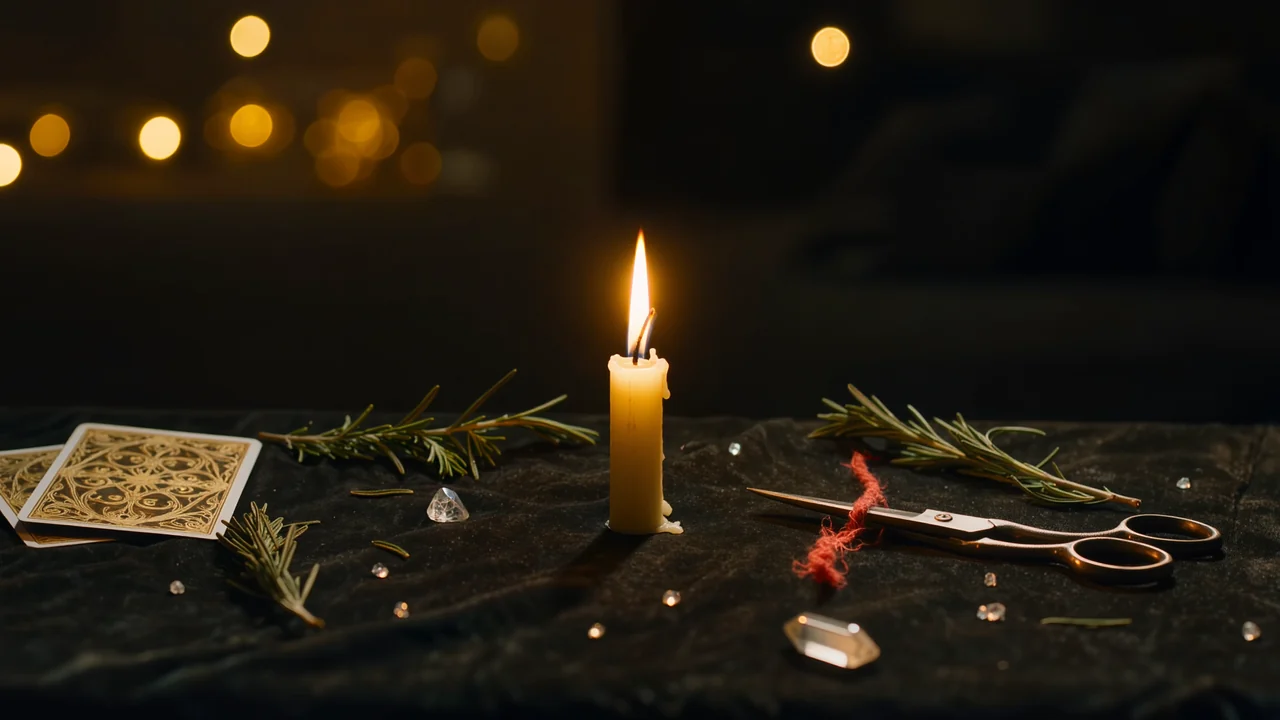
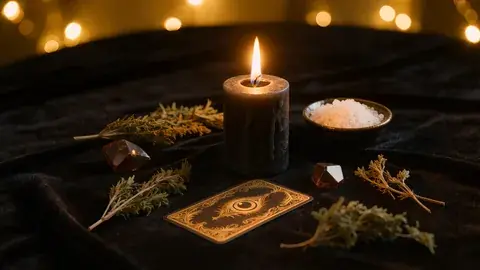
Put a candle on a stable surface, close the door, and give yourself five uninterrupted minutes. A tea light is enough; a taper candle gives you a longer flame to work with. Switch your phone to silent and leave it in another room, because a single notification in the middle of this pulls you straight back into the tie you are trying to loosen.
Name the cord out loud
Say the person's name and one plain sentence about what the connection does to you. Something like: "This cord with [name] leaves me drained every time we speak." Keep it factual. Blame turns the ritual into a fight you are having in an empty room, and it tightens your grip rather than releasing it.
See the cord, then cut it
Close your eyes and picture a line running between your chest and theirs. Notice its colour and texture without judging it. When you have it clearly in mind, open your eyes, pass your hand slowly through the space in front of you, and blow out the candle. That single gesture is the cut. You do not need to repeat it or make it dramatic.
Close with thanks, not revenge
Say one sentence of gratitude for whatever the relationship taught you, then one sentence that ends it: "I release you, and I keep my own energy." Gratitude is not forgiveness and it does not excuse anything. It simply stops the cord from being anchored in resentment, which is the strongest glue there is.
Ground yourself afterwards
Drink a full glass of water, slowly. Take ten breaths that are longer on the out-breath than the in-breath. Then walk around your home or step outside for a few minutes, feeling your feet land. Some people feel light and slightly unsteady after this, which is normal and passes.

The Day After: What to Do When the Pull Comes Back
If their name surfaces three days later, that is not proof the ritual failed. A cord that has been fed for months or years does not vanish in one evening; it thins, and thinning feels like a sudden tug rather than silence. What matters is what you do in the ninety seconds after you notice it. Name it plainly, even out loud: "this is the old pull, not a message." Then pick one small physical action, and make it dull on purpose. Rinse a glass, step outside for four breaths of cold air, text a friend about something unrelated. The goal is not to feel nothing; it is to prove to yourself that the thought can arrive and leave without you following it anywhere.
Some people repeat the ritual a week later, and that is fine. Repetition is not weakness, and it does not cancel the first working. If you feel the need, do the shorter version: the candle, the thread, the sentence you say as you cut. Keep it to ten minutes and skip anything elaborate. Shame is the only thing that actually feeds a cord, so treat a second pass the way you would treat watering a plant twice in a dry month.
There is a point where repeating the ritual stops helping, though. When the pull keeps returning with the same intensity and no detail changes, the tie is usually wrapped around something older than the person themselves: a pattern of being left, of over-explaining, of choosing people who need managing. That is where a personalised shadow work reading earns its place, because it looks at the pattern rather than the person. If you would rather not describe the situation at all, a blind reading with no questions asked works just as well, and many people find it easier to hear an answer they did not steer.
Cord Cutting With Family, Exes, and People You Still Love
Cutting a toxic cord with a parent or sibling rarely means disappearing from their life. It means ending the part of the bond that runs on guilt, obligation, or the role you were assigned as a child. You can still attend the birthday dinner, still send the message on their anniversary, and still keep the tie itself severed at the point where it drains you. Many people find the contact they choose feels lighter once the invisible debt is gone. If the family pattern repeats across generations, an ancestral reading can help you see which thread you inherited rather than created.
With an ex, the cord is usually habit, not love. The pull shows up as checking their profile at midnight, rereading old messages, or drafting a reply you never send. You are not trying to forget the years you shared. You are releasing the reflex to reach for them when you feel unsettled. Notice the hour of day the urge arrives, and put something small in that slot instead: a walk, a shower, a note in your phone about what you actually want next.
When you still love the person, the work is different again. You cut the pull, not the love. Love can stay in your chest without a cord attached to it, and it does not require them to feel it back. This is where twin flame language can quietly keep a cord alive, because it frames the ache as destiny rather than a tie you are free to loosen. If that story is holding you in place, a love psychic reading can separate the spiritual bond you value from the loop you keep feeding.
How a Reading Supports Your Cord Cutting
A ritual clears the space; a reading tells you what was standing in it. When you sit with a reader, the cards tend to surface the pattern underneath the tie rather than the person themselves: the role you keep playing, the moment the dynamic started, the reason a message from them still lands like a hook. That context is hard to see alone, because you are inside it.
A reading can also help you name which tie is actually yours to cut. People often arrive convinced the work is about one relationship, then find the pull traces back to an earlier one, a parent, a friendship, a version of themselves they have not quite released. Seeing that on the table changes what you do next. It is an emotional pattern reading, not a verdict, and it will not tell you what someone else is thinking or promise they will return.
What it offers is a next step: one gesture, one boundary, one conversation, one thing to stop doing. You leave with something to act on rather than a feeling you have to hold alone.
If you would like to try it, a personalised tarot reading arrives as a PDF by email, and your first one is free with the code WELCOME.
My picks



Pick one tie that keeps pulling you back into an old role, name it out loud, and cut it in a single unhurried gesture with a clear intention behind it. If you would rather have something to hold while you do it, the cord cutting ritual to remove toxic ties is there whenever you feel ready, and there is no rush to decide today.
Let a reading show you which cord is yours to cut
If you are not sure whether the tie you feel is love, habit, or fear, a Cord Cutting Ritual reading can name the pattern and give you a clear next step. Your first reading is free with the code WELCOME.
View Cord Cutting Ritual: Remove ToxicFrequently asked questions
Can I cut a cord with someone I still love?
Yes. You release the pull, not the love. The bond can stay warm while the draining habit ends. In practice, name what you are ending: the compulsive checking, the replaying of old arguments, the need for their approval. Light a candle, say that habit aloud, and let the flame hold it. Love can remain; the tug loosens.
How often should I do a cord-cutting ritual?
Once is enough to start, as long as your intention is clear and you name the person or situation precisely. Repeat it only when the pull returns, when you notice yourself replaying a conversation or checking their messages again. A fixed schedule turns a meaningful gesture into a chore, and the ritual loses its weight.
Will the other person feel it when I cut the cord?
You can't know, and you can't control what they feel. Some people report a shift in contact, others notice nothing at all. Keep your attention on your side of the tie: the knot in your chest, the urge to check their messages. That part is yours to loosen, and it's where the ritual does its quiet work.
What if I feel worse after cutting the cord?
Feeling heavier for a day or two can happen, and it usually means something is shifting rather than failing. Grief, tears or sudden tiredness often follow a release like this. Drink water, eat something warm, put your feet on the floor, and rest. Give it three or four days before you decide how it went.
Do I need special tools for cord cutting?
No, a candle, some quiet and honest words are enough. Tools simply support the intention; they do not replace it. If you already have a candle, a bowl of water or a piece of string, use what is there. What matters is the sincerity you bring to the moment, not the objects on the table.
Tarot readings and spiritual guidance are offered for personal reflection and entertainment. They do not replace medical, legal or financial advice.
Related readings

Aura Cleansing with Energy Reading and Spiritual Protection

Shadow Work Reading with Tarot for Emotional Patterns

Cord Cutting Ritual to Remove Toxic Bonds

Self-Esteem Reading with Self-Confidence Tarot

Inner Child Healing Tarot Reading
Related posts
 Salt Bath Energy Cleanse: How to Do It Right
 Full Moon Ritual for Release: A Simple Step-by-Step Guide
 Jealousy Energy Protection Ritual: A Gentle Guide
 Evil Eye Warning Signs: How to Recognize and Clear Them