


Yes or No Tarot: How to Get a Clear, Honest Answer
If you keep pulling cards until one of them finally says what you were hoping to hear, the yes or no tarot spread stops being a reading and turns into a negotiation. One question, one pull, one answer you accept the first time is what gives you something solid to stand on.
Want an answer right now? Try my free yes or no tarot reading online.
This is for anyone holding a single urgent question about a person, a message, or a decision, and who wants to stop shuffling in circles. You will find a simple way to phrase that question, which cards lean toward yes, no, or wait, and a short ritual to close the reading instead of reopening it.
In short
- A yes or no tarot reading works best with one clear question and one card, asked once.
- Upright and reversed, major and minor arcana all shift the answer; context matters more than a fixed list.
- If you keep re-asking, the cards are telling you the real issue is the decision, not the answer.
- When the answer is unclear, a deeper reading on the situation gives you more than another yes/no pull.
How to Do a Yes or No Tarot Reading (the Simple Way)
Hold one question in your mind while you shuffle
Decide what you are asking before your hands touch the deck. A single, specific question gives the cards something to answer: "Will he reach out this month?" works better than "What is going on with him?" Shuffle slowly, keep the question in your head, and stop when your hands feel done rather than when you have counted a certain number of shuffles. If you use a tarot reading for this, the same rule applies: one question per pull.
Pull one card and lay it face down
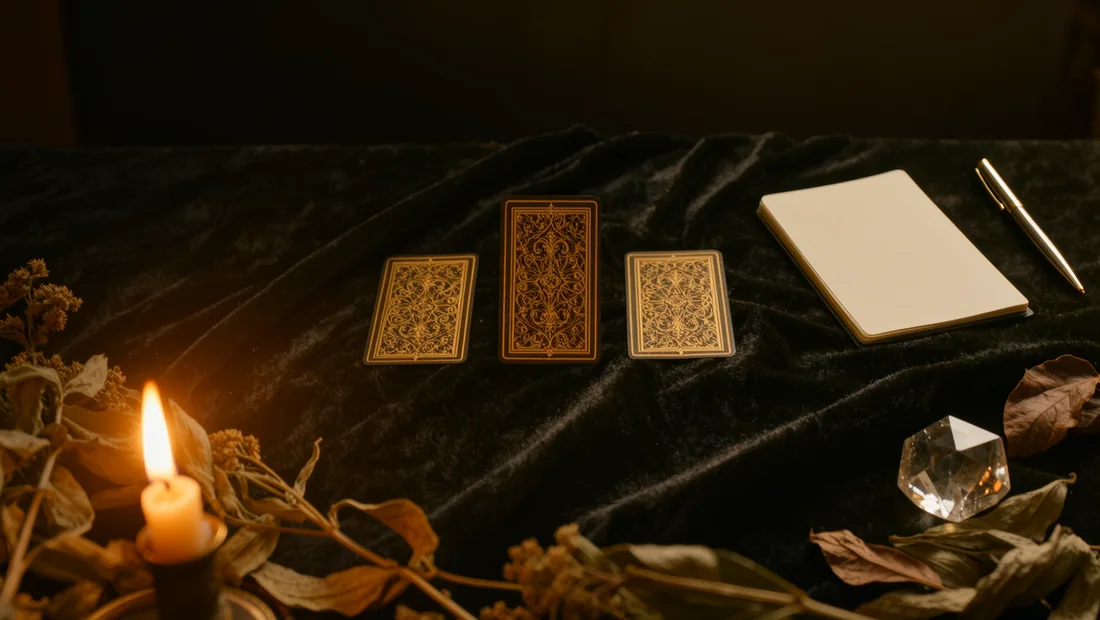
Draw a single card and place it in front of you without looking. Pause for a breath or two. Turning it face down first keeps you from reacting to the image before you have settled, which is often where the honest answer gets lost.
Turn it over and read the lean
An upright card leans toward yes. A reversed card leans toward no, or toward not yet. Treat that lean as a direction, not a verdict. A reversed Two of Cups might say the connection is not closed, just stalled. A reversed Ten of Wands might say the timing is wrong, not that the answer is a flat no.
Ask once, then sit with it
Put the deck down after the first card. Give the answer a day before you pull again. Pulling a second and third card on the same question usually means you are looking for a different answer, and the deck will keep giving you one until you stop.

How to Ask a Yes or No Question the Cards Can Actually Answer
A question the cards can answer is narrow, personal, and closed, and most people arrive with the opposite.
- Ask about your own move rather than someone else's inner life: "Should I text him first?" gives the cards something to weigh, while "Does he still love me?" asks them to read a mind they were never meant to open.
- Keep it to one decision. "Should I take the job and move cities?" hides two questions, and the card that lands will only speak to one of them, leaving you to guess which.
- Skip anything you have already decided. If you know you are going to send the message no matter what, the pull becomes a request for permission, and you will keep shuffling until you get it.
- Drop the word "ever" and the word "definitely". "Will I ever be happy in love?" cannot be answered by a single card, and the reading will feel hollow even when the card is kind.
- Name a timeframe when timing matters. "Is this a good month to ask for the raise?" is answerable; "Is this the right career?" belongs in a longer spread, such as a crossroads reading for a decision.
- Write the question down before you shuffle. Seeing it in your own handwriting exposes the double questions and the loaded ones faster than thinking it through.
- If the question keeps changing shape as you shuffle, that is your answer for today. Put the deck down and come back when the wording settles.
Which Tarot Cards Mean Yes, No, or Not Yet
Most cards do not carry a fixed yes or no. They lean in a direction, and that lean shifts with the question you asked and the position the card landed in. What follows is a working reference, the kind of shorthand readers keep in mind rather than a rulebook.
| Lean | Cards | How to read them |
|---|---|---|
| Usually yes | The Sun, The Star, The World, Ace of Cups, Ten of Cups | Open, warm, forward-moving. The Sun and The Star say the path is clear enough to walk. The World says a cycle is complete, so the answer is already forming. The Ace of Cups points to a beginning with feeling behind it, and the Ten of Cups to something that settles well over time. |
| Usually no, or pause | The Tower, Three of Swords, Five of Pentacles, Ten of Swords | These are not punishments. The Tower says the current structure will not hold. Three of Swords shows a hurt that is still raw. Five of Pentacles points to a lack of support around the situation, and Ten of Swords to an ending that has already happened. Read them as "this direction costs too much right now". |
| Not yet, or it depends | The Moon, Two of Swords, The Hanged Man, Four of Swords | The Moon says you are missing information. Two of Swords shows a choice you are avoiding. The Hanged Man asks you to wait and see it differently, and Four of Swords asks for rest before action. None of these are refusals. They are timing cards. |
Reversals change the tone more than the direction. A reversed Sun can still mean yes, with a delay or less shine than you hoped. A reversed Tower sometimes softens the blow, and a reversed Hanged Man often means the waiting has gone on long enough.
Context does the rest of the work. The Three of Swords in a question about whether to send a message reads very differently from the same card in a question about leaving a job. If you want a second set of eyes on a card that will not sit still, a personalised honest reading can help you see what you are too close to. You can also browse tarot readings built around single questions if you would rather not interpret alone.
Why Your Yes or No Reading Feels Wrong (and What to Do)
If the reading feels off, the most common reason is that you asked the same question more than once. Pulling a second card, then a third, then a fourth until one of them says what you were hoping to hear does not sharpen the answer. It dissolves it. By the fifth pull you are no longer reading; you are negotiating. Notice how many times you shuffled today. If it is more than once for the same question, that is your signal to stop and let the first card stand.
Anxiety distorts the reading in a quieter way. When you are frightened of a no, every card starts to look like one, and when you are desperate for a yes, a difficult card gets softened into something it never said. The card did not change. Your fear did the translating. A useful check: write down what you saw before you decide what it means. The image, the suit, the direction the figure faces. Then write what you felt. If the feeling arrived first and the meaning followed, you are reading your hope, not the card.
Give the answer a night to settle. Breathe slowly for a minute, put the card back in the deck, and write one line in a notebook: the question, the card, the date. Come back tomorrow before you act on it. Most people find the answer reads differently after sleep, and the pull that felt wrong usually turns out to be the one that was honest. If the same pattern keeps surfacing across several readings, that thread is worth following with shadow work tarot guidance rather than another yes or no.
Yes or No Tarot with Playing Cards or a Pendulum
A standard deck of fifty-two playing cards works for a quick yes or no when no tarot deck is nearby. Red suits, hearts and diamonds, lean toward yes; black suits, clubs and spades, lean toward no. The court cards usually point to a person involved in the situation, or to a delay, rather than a flat answer. Shuffle while holding your question, draw one card face down, then turn it over. For a slightly fuller picture, draw three: the first shows where things stand, the second the obstacle, the third the likely direction.
A pendulum answers in movement rather than symbols, which is why some people find it easier to trust. Rest your elbow on a table, hold the chain or cord between thumb and finger so the weight hangs still, and ask your question once. A swing front to back often reads as yes, side to side as no, and a slow circle as unclear or not yet. Decide what each direction means before you ask, not after, or you will read whatever motion you were hoping for. Ask once and let the swing settle.
Physical tools tend to feel steadier when emotions are running high, because your hands have something to do and your attention has somewhere to rest. That steadiness is the real benefit, not the object itself. If the answer still lands as murky, or the question keeps shifting each time you rephrase it, a fuller spread will serve you better than another single pull. A pendulum reading can confirm a direction, and a crystal ball session can open the wider picture when one word is no longer enough.

When a Yes or No Isn't Enough: Going Deeper
Some questions keep returning no matter how many times you shuffle. You pull the same card three days in a row, or a dream repeats a scene you can't quite place, or the decision in front of you has so many layers that a single word can't hold it. That's usually a sign you've outgrown the yes or no format. The card did its job: it pointed at something. Now the work is to understand what.
A one-card pull can tell you the temperature of a moment. It can't tell you why the same pattern shows up in your relationships, what your own hesitation is protecting, or how two possible futures actually differ. A personalised reading works differently. Instead of one card answering one question, a reader lays out a spread around your situation, reads the cards against each other, and writes it up for you as a PDF you can return to weeks later. That written form matters: you notice things on the second reading that you skimmed past on the first.
If your question sits in the territory of love, the love and soulmate readings are built for exactly this kind of layered situation, and a single love reading with soulmate guidance suits people who aren't in a relationship yet but keep sensing someone on the horizon. For questions that involve a specific person and a long history, the love psychic reading with twin flame predictions goes further into timing and recognition.
Your first consultation is free with the code WELCOME. You send your question, you receive a PDF by email, and you read it when you're calm enough to take it in. Nothing here promises an outcome, and no honest reader should. Think of it as a lamp held over a path you're already walking: it shows the ground ahead more clearly, and you still choose the steps.
A Gentle Ritual for Your Next Yes or No Pull
Set the Room Before You Set the Question
Light one candle and dim the lights until the room feels softer than it did five minutes ago. Turn your phone face down on the table, or better, leave it in another room. The point is not atmosphere for its own sake; it is to give your attention a single place to land, so the card you pull is the only thing in front of you.
Say the Question Out Loud, Once
Speak it in one sentence, then stop. Hearing your own voice keeps the question from drifting into a dozen smaller worries while you shuffle. If you want a calmer space for this, a little energy cleansing beforehand can help you start from a quieter place.
Pull One Card and Write It Down
Draw a single card, look at it for a slow count of ten, and then write the card name in a notebook with today's date. That written line matters more than the answer itself. In a month, you will read it back and notice how the situation actually moved.
Close with a Word of Thanks
Say thank you, whether the card pleased you or stung a little. Gratitude closes the reading cleanly and keeps you from pulling again five minutes later. If you want to keep working with this question over time, a new moon reading can hold the longer arc.
My picks



Ask once, then sit with the card you drew instead of pulling another. If the answer still feels murky, that fog usually points to a decision you have not fully named yet, and a wider spread on the situation will tell you more than repeating the same question. When you would like that fuller picture, you can look at the tarot readings available and choose whatever fits what you are actually facing.
Want more than a yes or no?
If your one-card pull left you with more questions, a personalised tarot reading by email can give you the context a single card can't. Your first consultation is on me with the code WELCOME.
View Tarot ReadingsFrequently asked questions
How do I do a yes or no tarot reading?
Shuffle the deck while holding one clear question in mind. Pull a single card. Upright, it leans yes; reversed, it leans no or not yet. Read that one card and stop. The answer is a direction, not a verdict, so let it settle before you act.
Is yes or no tarot accurate 100 percent?
No method is certain. Tarot offers an angle and a pause for reflection, not a guarantee. Treat it as guidance, not fate. The card shows a tendency, and your choices still shape what happens next. Use it to think, not to predict.
Can I do a yes or no tarot reading with playing cards?
Yes. Red suits lean yes, black suits lean no. Court cards often point to a person or a delay. Shuffle, ask one clear question, and pull a single card. Read the colour first, then the rank for extra nuance. The same one-card rule applies.
What if I keep getting maybe cards?
It usually means the question is too narrow or the situation is still moving. Ask a different, more open question, or book a fuller reading. A maybe card often signals that the real answer depends on a factor you haven't named yet. Try rephrasing to include that factor.
How many times can I ask the same yes or no question?
Once. Re-asking until you hear a yes muddies the reading and usually means the real issue is your fear, not the cards. If you feel pulled to ask again, sit with the first answer for a day. Then decide if you need a different question, not a repeat.
Tarot readings and spiritual guidance are offered for personal reflection and entertainment. They do not replace medical, legal or financial advice.
Related readings

3 Question Tarot Reading

Court Case Tarot Reading for Legal Guidance

Quick Psychic Reading with Urgent Tarot Answer

One Question Psychic Reading with Tarot and Clairvoyance

Career Psychic Reading with In-Depth Tarot Guidance
5 Question Tarot Reading with Honest Clairvoyant Insight
Year Ahead Tarot Reading: 12-Month Love and Career Forecast

Rune Reading with the Elder Futhark

Pendulum Yes or No Reading with Psychic Advice

Crossroads Tarot Reading for Life Decisions

Intuitive Reading: Blind Psychic Reading, No Questions Asked
Related posts
 Three of Wands in Tarot: Meaning, Love & Reversed
 Celtic Cross Tarot Spread: How to Read It
 Wheel of Fortune Reversed: Meaning & Guidance